
An historic floor loom at the Knockando Wool Mill. Photo: Girth Summit / Wikimedia Commons (CC BY-SA 4.0).
Overview
Every loom holds warp threads under tension so that the weaver can pass weft through alternating openings called sheds. What distinguishes one loom type from another is how sheds are formed, how many distinct thread groupings can be controlled independently, and how wide and long a piece can be woven.
In practical terms for Canadian crafters, the three most commonly encountered categories are frame looms, rigid heddle looms, and floor looms. Each suits a different combination of available space, budget, intended project type, and structural complexity.
Frame Looms
A frame loom is any rigid rectangular or square frame on which warp threads are strung from peg to peg, top to bottom. It has no moving parts: shed formation happens by hand, using a shed stick inserted between warp layers to open a gap, or by lifting individual threads with a needle or stick shuttle.
Construction and Setup
Frame looms are among the least expensive and most portable options. A basic stretcher-bar frame from an art supply shop can function as a simple loom. More purpose-built versions include evenly spaced notches or pegs at top and bottom to keep warp threads at consistent spacing. Spacing typically runs between four and eight threads per inch for chunky to medium-weight yarn.
Warping a frame loom involves wrapping yarn continuously around the pegs in a figure-eight or straight pattern. The crossing of threads at the centre or at one end creates a natural shed that can be held open with a flat stick. The alternate shed is formed by reaching between every other thread with fingers or a pick-up stick.
Suitable Projects
Frame looms are well suited to tapestry work, small wall hangings, and woven patches or pocket squares. Because they produce cloth only as wide as the frame itself (typically 20–40 cm for hobby frames), they are not practical for yardage. Their strength is in pictorial or colour-blocked weaving where the weaver works from a cartoon (a drawn design placed behind the warp as a reference).
Structural Limitations
Without a beater, consistent weft density requires manual adjustment after each pick. Selvedges on frame-loom work need attentive bubbling of each weft row. Finished pieces often have a slightly uneven weft density compared to loom-woven cloth, which can be an intentional textural quality in tapestry work.
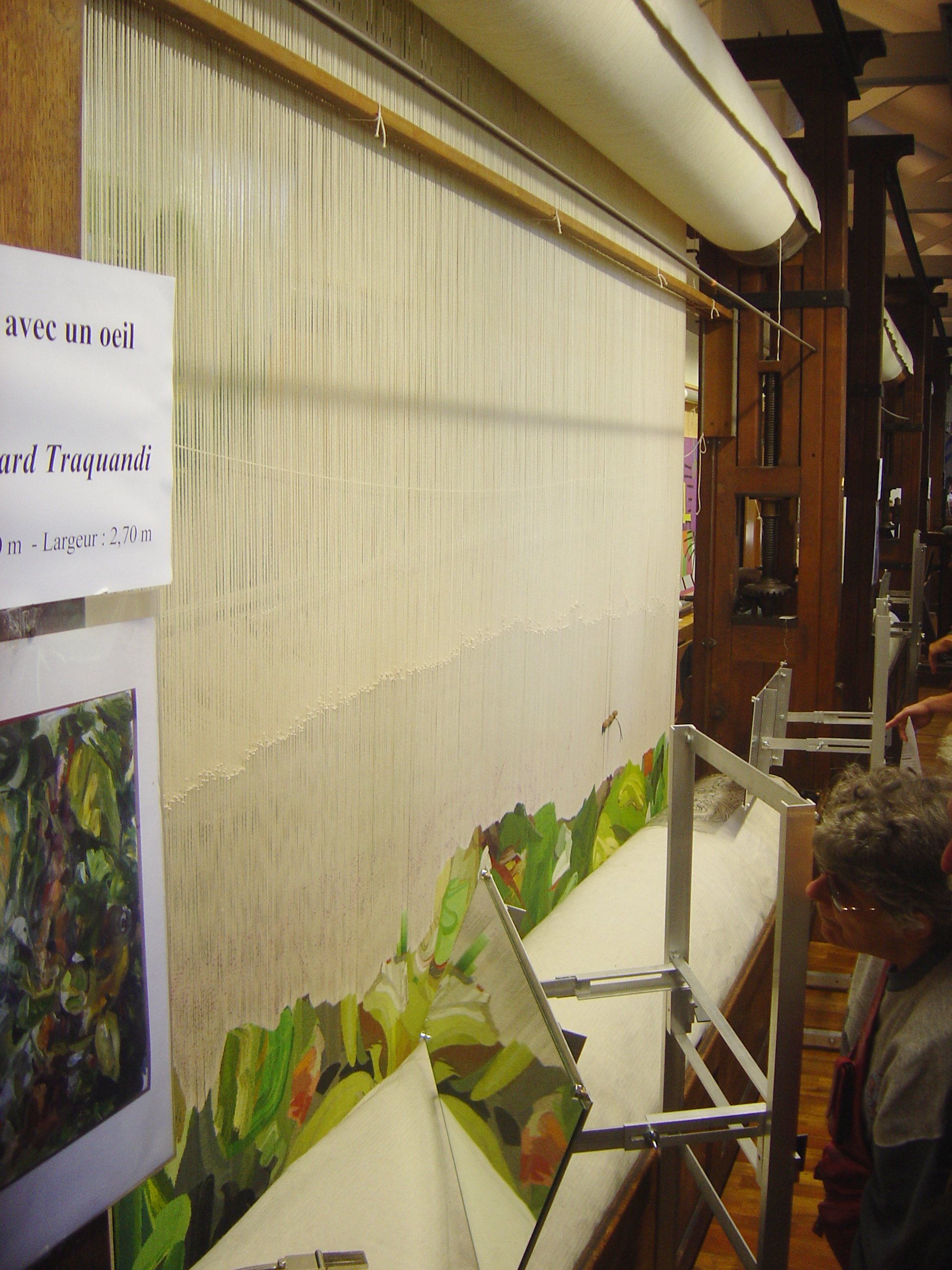
A haute lisse (high warp) tapestry loom at the Gobelins manufacture, Paris — a professional vertical frame loom. Photo: David Monniaux / Wikimedia Commons (CC BY-SA 2.0 FR).
Rigid Heddle Looms
A rigid heddle loom adds a single perforated board — the rigid heddle — to the basic frame concept. The heddle contains two types of holes: slots (open channels between rigid strips) and holes (small circular openings through which individual warp threads are threaded). Raising the heddle creates one shed; pressing it down creates the alternate shed.
Construction and Operation
The rigid heddle sits between a front beam (warp beam) and a back beam (cloth beam) in a simple two-beam frame. Warp thread is tensioned by ratchet mechanisms on the beams. The heddle also functions as the beater: after each weft pick, the heddle is pressed forward to pack the weft against the previous row.
Most rigid heddle looms are sold in standard widths: 25 cm, 40 cm, 60 cm, and up to 90 cm or more. Canadian manufacturers and retailers such as Leclerc Tissage in Québec produce rigid heddle models alongside their floor loom range. Imported brands including Ashford (New Zealand) and Schacht (USA) are also widely available through Canadian yarn shops.
Threading and Sett
Rigid heddles are sold in specific sett sizes, expressed in holes and slots per inch (e.p.i.). Common sizes are 5 dpi, 7.5 dpi, 10 dpi, and 12.5 dpi. Each heddle size is optimal for a range of yarn weights: a 10 dpi heddle works well with DK or light worsted weight wool; a 5 dpi heddle handles bulky or chunky yarn. Some weavers stack two heddles of the same or different sett to increase pattern possibilities.
Pattern Possibilities
With a single heddle, the rigid heddle loom produces plain weave (over-one-under-one) in its basic operation. Pick-up sticks inserted between slot threads and hole threads can create simple pattern variations including lace, weft floats, and basic colour blocks. With two heddles and a pick-up stick, basic twill structures become accessible. However, the rigid heddle loom cannot replicate the full range of structures achievable on a multi-shaft floor loom.
| Heddle Size | Yarn Weight | Typical Projects |
|---|---|---|
| 5 dpi | Bulky, super bulky | Rugs, wall hangings, thick scarves |
| 7.5 dpi | Worsted, chunky | Scarves, wraps, small blankets |
| 10 dpi | DK, light worsted | Scarves, towels, table runners |
| 12.5 dpi | Sport, fingering | Lightweight scarves, yardage samples |
Floor Looms
A floor loom is a large, freestanding structure with four or more shafts suspended from an overhead castle, each controlled by a treadle tied to the floor. Lifting combinations of treadles lifts specific shaft combinations, opening the shed for the weft shuttle. A beater attached to the castle is swung forward after each pick to consolidate the weave.
Shaft Count and Structure Range
The defining characteristic of a floor loom is shaft count. A four-shaft loom can produce all basic structures: plain weave, twill (2/2, 3/1), and derivatives including basket weave, hopsack, and simple overshot. An eight-shaft loom opens up more complex twill variations, double weave, collapse weave, and many traditional pattern drafts documented in reference works such as Strickler's A Weaver's Book of 8-Shaft Patterns. Sixteen-shaft looms allow highly intricate structures but require a significant investment in both equipment and technical knowledge.
Major Canadian Manufacturers
Leclerc Tissage, based in L'Islet, Québec, has produced floor looms for over a century and exports across North America. Their Fanny and Nilus models are commonly found in Canadian weaving studios and guilds. Cranbrook-style looms, often built by Canadian craftspeople from published plans, are another traditional floor loom format with a dedicated following.
Space and Setup Requirements
A four-shaft floor loom with a 90 cm weaving width requires a footprint of approximately 120 × 150 cm, plus working clearance in front and behind. Weight runs between 70 and 150 kg for solid hardwood construction. Most are delivered in pieces and assembled on-site. A level, load-bearing floor and adequate ceiling height (typically 200 cm minimum) are practical requirements.

A mechanised loom weaving tartan at Lochcarron, Scotland — the structural principles of beater and shaft operation are identical to hand floor looms. Photo: Karora / Wikimedia Commons (public domain).
Choosing a Loom for Canadian Conditions
Humidity variation is a practical consideration in Canadian studios. Wooden looms, particularly those with mortise-and-tenon construction, can loosen in joints during dry winters if the studio is heated without humidification. Some weavers apply periodic oil treatments (raw linseed or Danish oil) to prevent cracking. Steel-framed looms are less affected by humidity but are less common in handcraft contexts.
Canadian weaving guilds, including the Handweavers Guild of Canada and its provincial affiliates, maintain studio spaces where members can trial different loom types before purchasing. The guild lending library system also circulates looms for short-term use, which is a practical way to assess a loom category before committing to a purchase.
References
- Ashenhurst, Thomas Robert. Design in Textile Fabrics. Cassell, 1883. (Digitised, Internet Archive)
- Davison, Marguerite Porter. A Handweaver's Pattern Book. Swarthmore, 1944.
- Leclerc Tissage — Canadian loom manufacturer, L'Islet, Québec.
- Handweaving.net — Draft archive and pattern database.